Criteria Language Proficiency Test – Spanish-Latin America (CLPT-ESLA)
 Updated
by
Amy Thomas
Updated
by
Amy Thomas
At a glance
Type of assessment | Skills |
Measures | Level of proficiency in Spanish |
Time | 7-28 minutes |
Format | The CLPT – Spanish is broken into four modules: Reading, Writing, Listening and Speaking. |
Workplace outcomes | Reduced training requirements Increased productivity |
Recommended for | Recommended for any role that requires a level of Spanish proficiency. |
Description
Identify the best candidates who are proficient in the Spanish language using a fast and adaptive skills assessment. The Criteria Language Proficiency Test – Spanish-Latin America is designed to measure candidates’ ability to understand and communicate in English across four skill areas. By assessing a candidate’s Spanish proficiency, employers gain surety in a candidate’s grasp of Spanish and can easily identify candidates with a satisfactory language level for a given job.
The CLPT – Spanish-Latin America has a short-form counterpart, the CLPT Express – Spanish-Latin America, which contains 12 questions overall.
Format
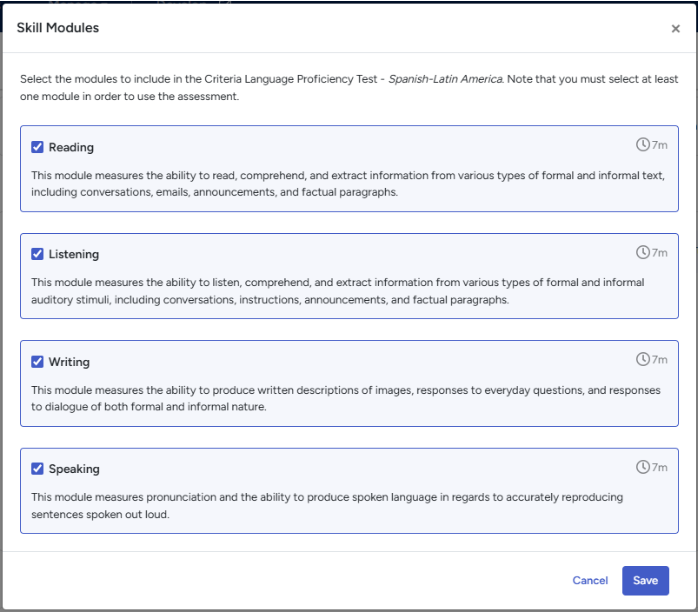
The Criteria Language Proficiency Test comprises 4 modules:
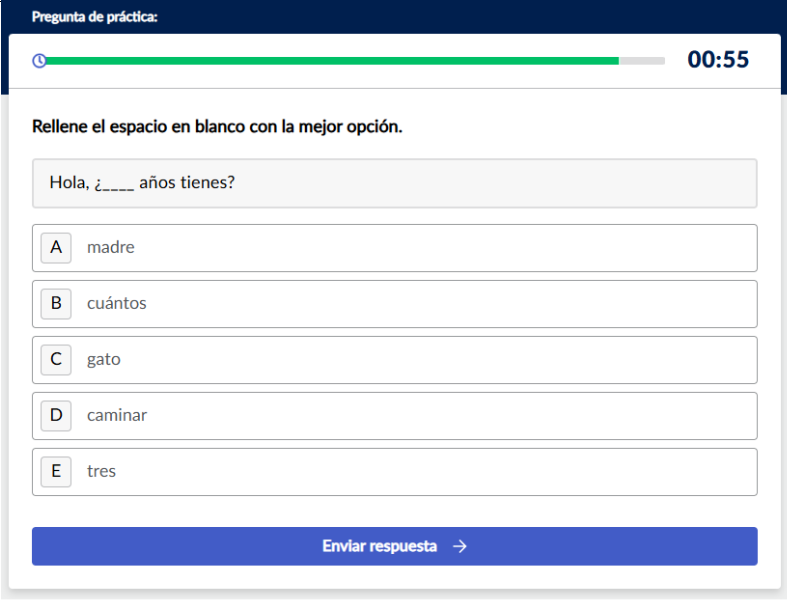
- Reading: contains 13 multiple-choice questions
- Writing: contains 8 free-text questions
- Listening: contains 13 multiple-choice questions
- Speaking: contains 8 questions
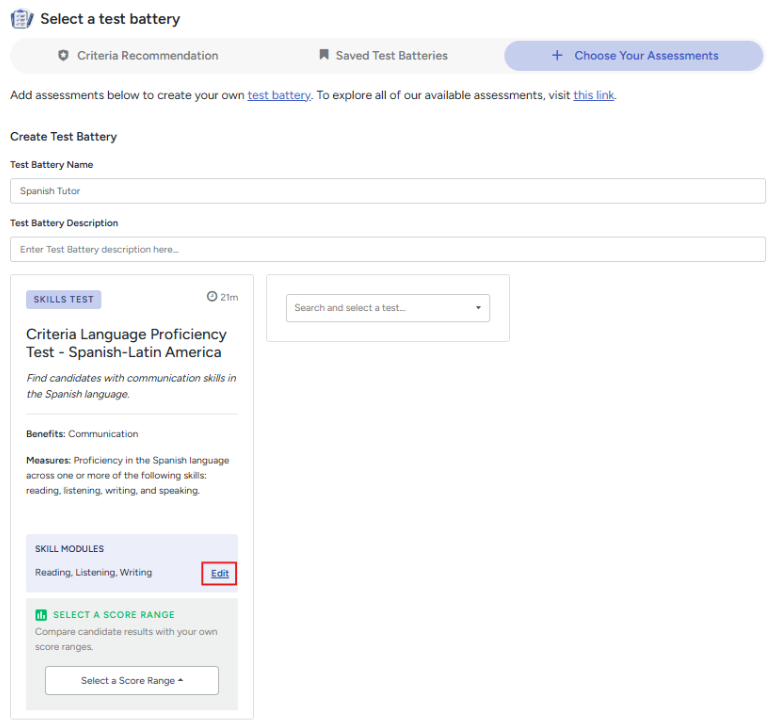
Employers are free to select any combination of modules for the CLPT - Spanish within a test battery, when creating or updating a job.
Should I use the CLPT or the CLPT Express?
CLPT – Spanish | CLPT Express - Spanish |
Modular - choose any combination of Reading, Writing, Listening and Speaking | Assess Reading, Writing and Listening |
Up to 28 minutes to complete | 7 minutes to complete |
View individual scores for each skill area | View one overall proficiency score |
View Common European Framework of Reference for Languages (CEFR)-equated scores | No CEFR-equated score available |
Pick and mix required skills
The CLPT – Spanish has a unique modular structure, allowing employers to select only the skills that are relevant to the particular role they are recruiting for.
For example, employers hiring for call centre positions may wish to assess only Spanish Listening and Speaking, whilst employers hiring for more general positions may choose to assess the full complement of Reading, Writing, Listening, and Speaking.
Assess basic to advanced Spanish skills
A broad range of skills can be assessed in the CLPT - Spanish from beginner through advanced levels. For clients who wish to equate scores on the CLPT - Spanish to more global measures of Spanish language proficiency, a Common European Framework of Reference for Languages (CEFR)-aligned score is also provided in candidates’ score reports.
Skills covered
Reading | Writing | Listening | Speaking |
- Reading comprehension - Vocabulary - Spelling and grammar | - Image description - Short response writing | - Listening comprehension | - Speaking ability |
Intelligent scoring
For improved test security, your candidates will be streamed different questions from a large bank of items. This means that no two candidates are likely to be presented with the same set of questions, making it harder for candidates to cheat or prepare for specific questions.
Instant scoring for the Writing component of the CLPT - Spanish is made possible through the use of a trained and fine-tuned natural language model.
Useful and immediate insights
Detailed score reports provide you with immediate insights including:
- Score: a numerical score indicating how the candidate performed relative to other people who have completed the assessment
- Proficiency rating: a rating of Spanish proficiency from Beginner to Advanced
- CEFR Level: a rating of Spanish proficiency at the individual skill level, which is equated to the Common European Framework of Reference for Languages (CEFR)
